UML Package Diagram Examples
Here we provide some examples of UML package diagrams:
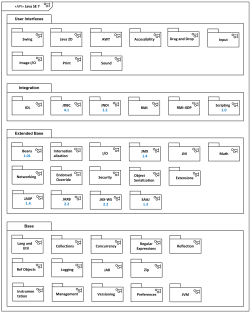
 Java™ Platform Standard Edition 7 API UML package diagram example.
Purpose: An example of UML package diagram representing Java™ Platform Standard Edition (SE) 7 API.
Summary: Java™ SE 7 API is comprised of several modules - User Interface and Toolkits APIs, APIs of Integration Libraries, Other Base Libraries APIs, lang and util Base Libraries APIs, Java Virtual Machine (JVM) API. Java SE 7 API includes such well known APIs as Swing, AWT, JavaBeans, JDBC, JAXP, JAX-WS, JAR.
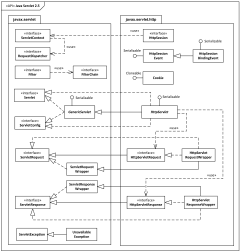
 Java Servlet 2.5 API UML package diagram example
Purpose: An example of UML package diagram representing most important interfaces and classes of Java™ Servlet 2.5 API.
Summary: Java Servlet 2.5 API consists of two packages: javax.servlet and javax.servlet.http. The javax.servlet package contains a number of interfaces and classes (both abstract and concrete) that describe and define the contracts between a servlet class and the runtime environment provided for an instance of such a class by a conforming servlet container. The javax.servlet.http is package specialized for the servlet class running under the HTTP protocol and for corresponding runtime environment.
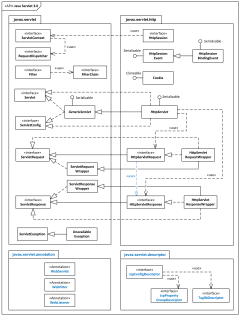
 Java Servlet 3.0 API UML package diagram example
Purpose: An example of UML package diagram representing most important interfaces and classes of Java™ Servlet 3.0 API.
Summary: Java Servlet 3.0 API consists of four packages: javax.servlet, javax.servlet.http, javax.servlet.annotation, and javax.servlet.descriptor. The javax.servlet package contains a number of interfaces and classes (both abstract and concrete) that describe and define the contracts between a servlet class and the runtime environment provided for an instance of such a class by a conforming servlet container.
The javax.servlet.http is package containing API interfaces and classes specialized for the servlets supporting HTTP protocol and corresponding runtime environment. The javax.servlet.annotation and javax.servlet.descriptor packages allow to declare servlets, filters and listeners by using annotations and to have access to a web application's configuration information.
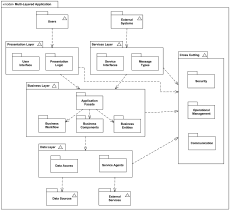
 Multi-Layered Application Model
Purpose: An example of UML model diagram representing a model of a layered application, based on the Microsoft Application Achitecture Guide, 2nd Ed.
Summary: Application model shows several layers - presentation layer, services layer, business, data, and cross-cutting layers. All layers are represented as UML models.
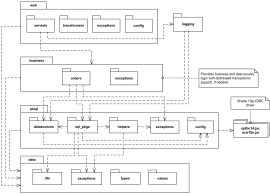
 Multi-Layered Web Architecture
Purpose: An example of UML package diagram representing some multi-layered web architecture.
Summary: Dependencies between packages are created in such a way as to avoid circular dependencies between packages. Higher level packages depend on lower level packages. Packages belonging to the same level could depend on each other. Data transfer objects and common exceptions are used by packages at higher levels.
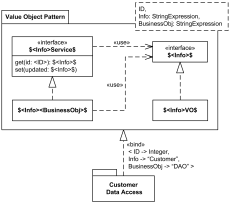
 (Data) Transfer Object (Value Object) design pattern package template
Purpose: A UML package template example for the design pattern known as Transfer Object in Core J2EE patterns [CJ2EEP 02] or Data Transfer Object (DTO) in Microsoft .Net Application Architecture Guide [MAAG 09]. It was also known as Value Object (VO) in older version of J2EE design patterns.
Summary: (Data) Transfer Object is some "coarse-grained" data structure intended to be moved across different boundary layers or transported over the network, usually serializable, so that a single method call could be used to get or to send the whole Transfer Object to reduce the number of remote calls. Examples of DTOs are Customer, Purchase Order, Account, etc.
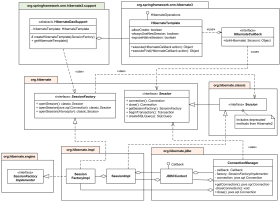
 Spring and Hibernate ORM data access packages and classes
Purpose: An example of UML package diagram representing some Spring and Hibernate data access packages and classes.
Summary: The Spring Framework provides integration with several Object Relational Mapping (ORM) data access technologies including Hibernate, JDO, Oracle TopLink, iBATIS SQL Maps and JPA. Support packages for object relational mappers comply with Spring's generic transaction and DAO exception hierarchies.